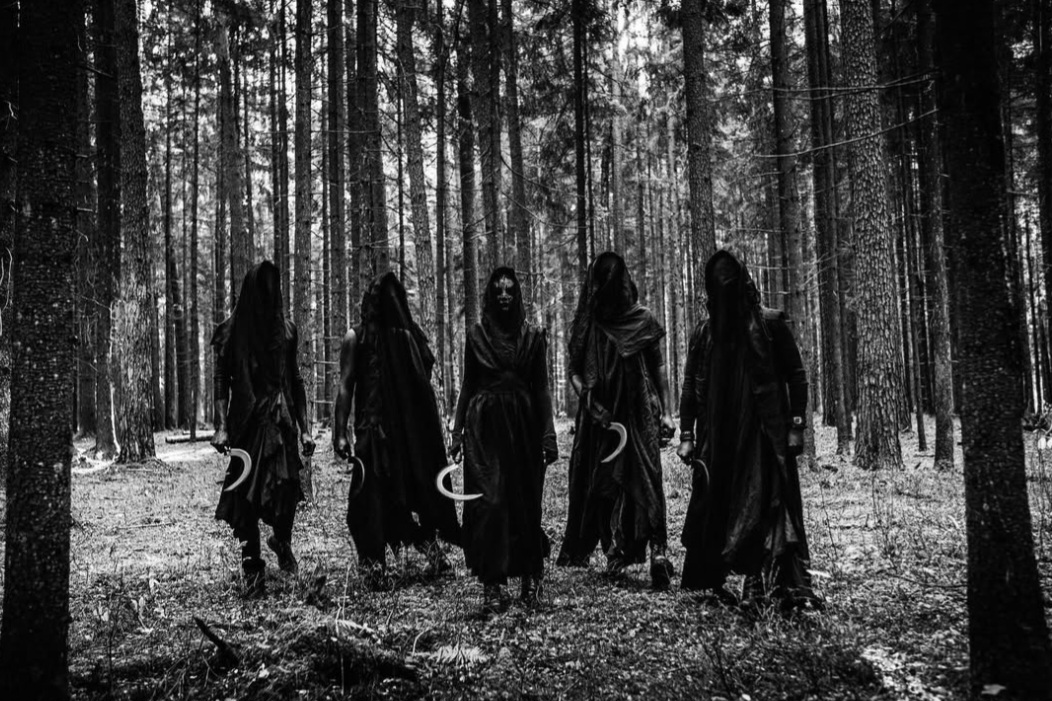
A while ago I received an intriguing email from someone called Nyan Cat – I mean, at least that’s why her email address said – asking if I would like her to interview some bands for the website and her YouTube channel.
As I said, I was intrigued, so after some back and forths during which I found out she was Belarusian and that Belarus has an incredibly active Black Metal scene – which is a homerun for the likes of me – as well as a couple of false starts – such as one band who will remain nameless refusing to do the interview due to not liking our slogan, meaning their either against the underground or anti antifascist – she managed to land some time with arguably the biggest Black Metal band in Belarus, the brilliant Ciemra.
What follows is the transcript of their conversation, which you can find in video form on her YouTube Channel and which I know you are all going to go subscribe to now as you are lovely people, and if you want to join her growing Telegram community then you can do that via this link.
Anyway, enough of my waffling, today the Black Metal Archives is proud to present:
Interview with Ciemra Conducted by Sofia Sitnik.

Sofia Sitnik: In several interviews that already exist, I have received answers to questions about which bands influenced your work and how you came to form Ciemra nominally in 2017 and officially in 2019 (when, in addition to you, Misery, two more first members appeared). What do you think about your attitude towards the iconic black metal band Mayhem? Perhaps its sound affected you personally?
Ciemra: I would be lying a lot if I said that Mayhem didn’t affect us in any way. This is a legendary band with a very interesting, intensively developing and rather controversial history. In my opinion, every new strong band would like to be a little bit like them, whether it’s history, nicknames, behavior (excluding crime), and if they say they don’t want to, they blatantly lie. Regarding the sound, I’m personally touched by guitars, which can be played with pleasure on acoustic instruments and feel good.
Sofia Sitnik: In an interview, you also mentioned that the recording of your second album The Tread of Darkness took place among bare walls and sleeping bags, for a whole week without a break. As far as I understand, this was done in order to give the material a special atmosphere and help you, and then your listeners, feel it. Do you plan to do the same with future jobs?
Ciemra: Yes, we listened to everything we wrote in the bare walls, consisting of concrete, a table and a couple of chairs, and spent the night on concrete in Alexey Osipenko’s studio, which no longer (unfortunately) exists. We arrived at 7 a.m. and left at 5 a.m., or even at all – “sleeping bag + hot water bottle + Gorgoroth”. We must pay tribute to Alexey – he put a lot on this record. But we didn’t do it on purpose. We were forced to work in such conditions, because at that time repairs were being carried out in the building where the studio was located. And in the studio, too. The only constantly visited and beloved room was the one where the drums were recorded. Today, I can safely say that the tracking of the album The Tread Of Darkness took place blindly (in terms of guitars). But this is not a mistake, but how it should have been. And today, remembering this, I smile in a good way, because I respect and love every second of this process. Alma Studio was a very strong point.
Sofia Sitnik: Only about a year has passed between your first album Agony Blasphemy and the second The Tread of Darkness. And yet, do you feel any evolution in sound and approach during this time?
Ciemra: Maybe I’ll “discover America” for you, but The Tread of Darkness was written and thought out a year earlier than even Agony Blasphemy was written. We understand that we are not the first and not the last in our business. It was very interesting to see how people reacted to the raw pitch. We drew conclusions and carried out work on the mistakes, which we are still doing today. Speaking of people’s reactions, they satisfy us. Definitely.
Sofia Sitnik: Starting in 2022, your albums will be released on Avantgarde Music (formerly Obscure Plasma Records), a label with a rich heritage in the world of Black Metal. Within its framework, you found yourself on the same list with genre legends such as Mayhem, Behemoth and the Carpathian Forest. Do you feel any pressure or inspiration from this?
Ciemra: We feel great with Avantgarde Music. Roberto Mammarella (founder of the label – editor’s note) is a very sensitive and even person. No pressure. It’s a super professional label that knows what it’s doing, and we’re very similar in that. We are extremely happy to be a part of the story that we are making together, despite the standards.
Sofia Sitnik: You use both English and Belarusian in your texts. Is there a clear division for you into which topics, emotions, or messages require a native language, and which are universal and addressed to the world stage?
Ciemra: It’s more at the level of subtle sensations. I know exactly what should be and sound like in my native language, and what should be understood by everyone around me when I write. Let’s do this. The native language is an intimate one, accessible only to those who want to learn more, and English is something that everyone should hear and know. At the same time, fans who don’t understand our native language feel the very points of contact and vibrations that speak more than words. Anyway, we speak the same language, the language of Darkness.
Sofia Sitnik: How do you arrange and distribute the parts? Does every member of your band have their own voice and vision, or are you in charge of everything one way or another as a frontman?
Ciemra: There are only 5 of us(vocals/guitar/guitar/bass/drums), and in our band, everyone who is a part of it matters. Decisions are made very deliberately.
Sofia Sitnik: Three members of your band play in parallel in the atmospheric black metal band Samota (in Belarusian that means “Loneliness”). Do these two teams influence each other? Is there some kind of intersection of ideas, or are these two different worlds with their own themes and concepts?
Ciemra: Samota is a DSBM band, to be precise. The story of our interaction deserves a separate interview, really. We were born out of Darkness. Understand it however you want. The founder of Samota, Mrok, will tell you the rest.
Sofia Sitnik: In 2023, you launched not only merch, but also a collaboration with Malanka brewery (in Belarusian that means “Lightning”), releasing a double black IPA under your name. I know a lot of bands in different genres that produce craft alcoholic beverages. But still, how did you come up with this idea and do you have any other unexpected creative ideas in your plans?
Ciemra: Our cooperation with the guys from Malanka began a few years ago, when we saw their variety “CIEMRA”, we immediately got in touch. They responded immediately and proved themselves to be professionals. I was invited to the brewery. And somehow we did it by ourselves. First, a couple of cans, and then a whole separate style. Wonderful people, they know what they are doing, how and for whom. Now you can try this beer at the address listed on their website. Highly recommended. There’s a lot of delicious beer there besides Ciemra, believe me. There are further plans, but we won’t tell you yet.
Sofia Sitnik: Your first large-scale tour in the summer of ’23 together with the Grodno band WOE UNTIL ME covered five European countries. Tell us how this trip went, did you notice any cultural differences in the perception of Black Metal in different countries, and what was the most interesting thing you remembered?
Ciemra: Yes, this tour has become a wonderful experience, for which, of course, thanks to Artem Serdyuk (Woe Until Me/Disloyal/Deathbringer). He made this trip possible, and in every sense proved himself to be a competent tour manager who works with bands of a higher echelon to this day. I’ll just say that perceptions and differences in culture from different countries were the least of our worries at the time. It was unforgettable.
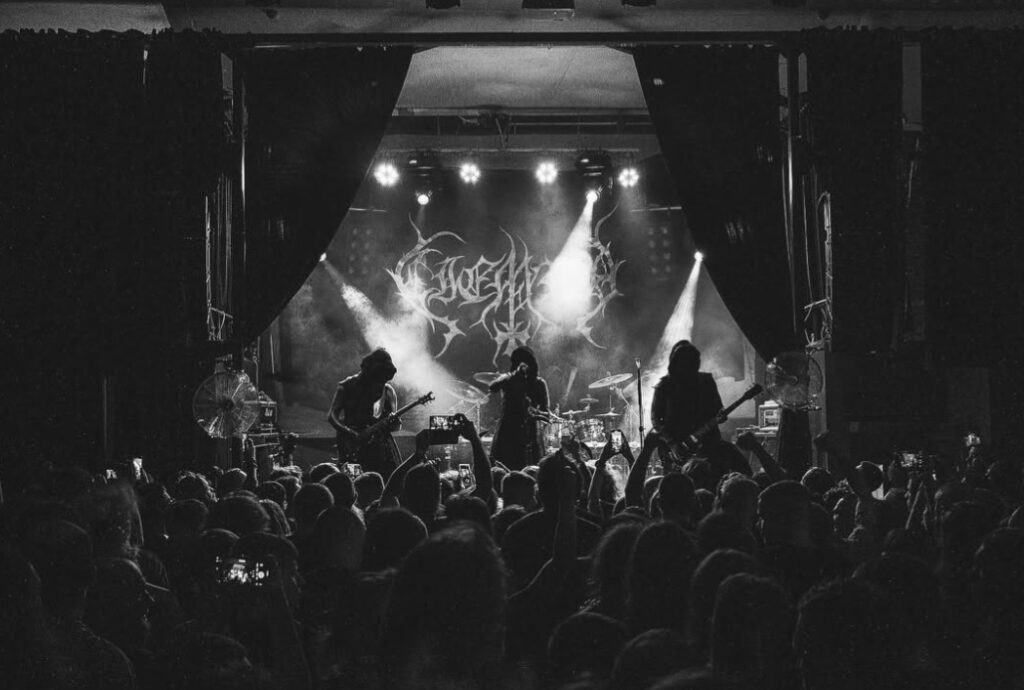
Sofia Sitnik: After that tour, you performed at the In Flammen Open Air with Napalm Death, Benediction and Impaled Nazarene, and at The Fall Festival with Gorgoroth and Aeternus. Was there a moment among these performances that you remember as a turning point – as something that “moved you to another rank”, from the Belarusian underground straight to the European Metal Olympus?
Ciemra: I can’t say that this has somehow “moved us to another rank” or to some kind of “Olympus”. The only thing that really struck us was the professionalism and the way these artists work. We shared our experiences with great pleasure, both behind the stage and on it. We understood one thing – everything that is done here is done with blood and sweat, and in no other way. Each of the names you mentioned has thousands, if not tens of thousands of such performances behind their backs. And you can feel it just by looking at it, shaking hands. These are very strong people, and a very strong scene that has no equal (here I’m talking about Black Metal in general). And we are very happy to be a part of it.
Sofia Sitnik: How do you choose which ideas for new releases to keep and which to postpone or delete? Do you have a “demo graveyard”, and should we expect that, according to the Gehenna model, you will use some kind of deferred material after 10 years?
Ciemra: We have a very rigorous selection process for each demo. You know, I try to write in such a way that none of this falls into the “graveyard”. There are things that are several years old. And if we decide that they deserve to be on the next album, so be it.
Sofia Sitnik: In the 2024, they came home to the now closed club Bruges, where they performed with two of the most famous bands from the Belarusian black underground – Amok and Coldrope. How has the local scene changed during your absence then, and is there any hope that we will see you again here in Belarus in the near future?
Ciemra: I believe that the BM scene in Belarus is currently at the peak of its potential. We have a lot of decent teams in our country. I don’t know what gave the main impetus, but I know for sure that we won’t be the last in this story. We are making every effort to return to Minsk and Belarus with new things, with a new, more massive sound, but still with the same old beliefs and truths. With what was, is, and will be called Darkness.
Sofia Sitnik: In March 2026, a concert is expected in Warsaw with the Polish-Belarusian band Vokkr. How do you feel about the many bands like yours that have left their native country and are now sharing the foreign stage with you?
Ciemra: We have several concerts in March 2026, and if we are talking about the one, then this is a concert with the Kroda band from Ukraine. You know, each team has its own ways and methods. Those who have left their homeland due to circumstances (forced or not) – they want recognition, one way or another. They achieve this in different ways too. We have one thing in common – art. Anything that goes beyond the “Black Square” is not of interest to us.
Sofia Sitnik: If you could describe the philosophy of Cemra in one sentence, what would you say?
Ciemra: Never lower the black banner, and do not throw the sword, otherwise you will lose.
Sofia Sitnik: What can you wish for newcomers to the genre?
Ciemra: To be ourselves, in the flow, in the Darkness, we will always find each other.